
Scalable Dashboard Patterns
Unifying T-Mobile across brands through a scalable, system-driven dashboard
Lead designer
Web

Problem
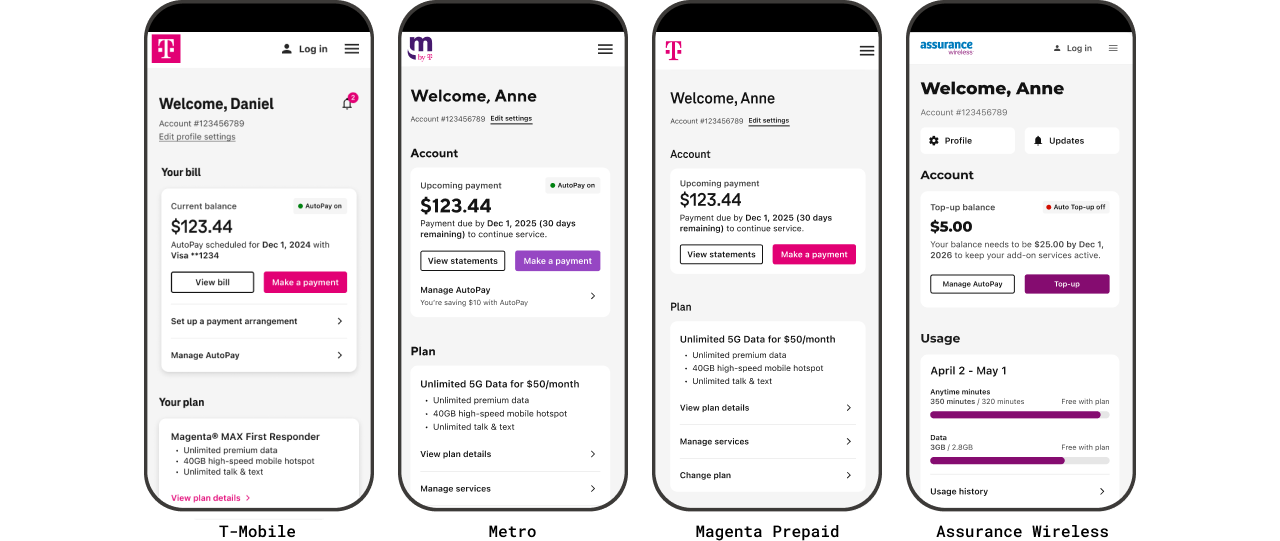
Fragmented dashboard experiences lacked consistency and scalability across brands.
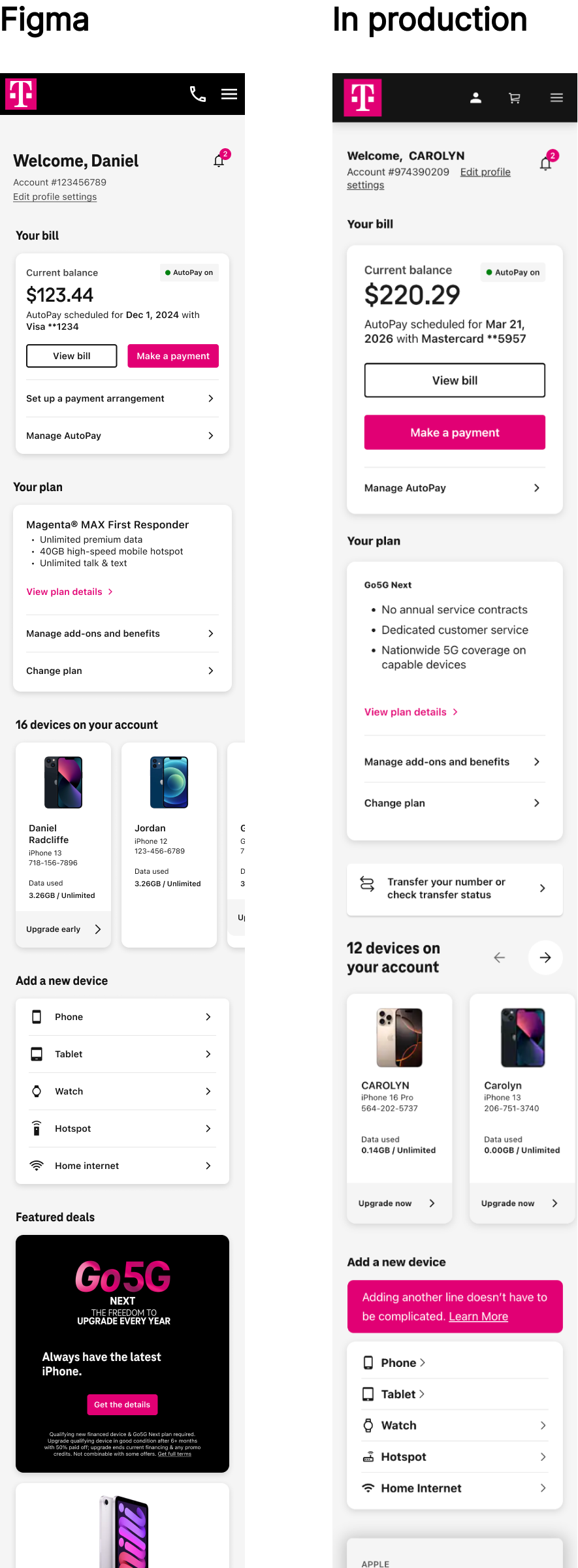
While updating the Metro by T-Mobile dashboard, I uncovered inconsistencies between live experiences, Figma designs, and related design files.
Dashboards had been built as one-off solutions without shared components or patterns, creating disconnected customer experiences, inefficient workflows, and challenges scaling account management across brands and platforms.

Solution
Developed a modular dashboard system that consolidates core metrics and visualizations across brands, utilizes brand-flexible modules, supports future scalability, and integrates the updated design system.
Impacts

Cross-Platform Consistency • Established a scalable, component-driven architecture across web and app dashboards

Faster Feature Delivery • Created reusable patterns that accelerated feature rollout and reduced design and development rework

Conversion Paths • Created prominent CTAs for swatches and promotions to support quicker purchase decisions.

Scalable Brand Flexibility • Unified core interactions while preserving brand-specific requirements and identities

Reduced Design Debt • Reassessed legacy patterns and established standards to prevent redundant solutions from carrying into future releases
Process
Discover
Research

Audits • Evaluated dashboards and UI patterns across brands

User Research • Interviewed stakeholders, surveyed customers, and moderated usability tests

Journey Mapping • Mapped cross-brand flows and interactions

Benchmarking • Analyzed scalable dashboard patterns
Insights
Inconsistency • Fragmented patterns created confusion and inefficiency
Redundancy • Repeated components lacked standardized implementation
Hierarchy • Users needed clear overviews with brand-specific details.
Scalability • Shared patterns could unify experiences without sacrificing brand identity.
Define
Scope & experience strategy
Negotiated priorities across brand managers and product while advocating for the customer
Aligned on core metrics, visualization standards, and component hierarchy
Expanded scope beyond dashboards to include device details and plan details across brands

Defined end-to-end flows for prepaid brands, independently driving UX strategy in lower-complexity surfaces
Design decision
Build a modular, brand-flexible design system that accommodate contextual differences with established variants
Design
I iterated on layouts, information hierarchy, and interactions to balance consistency, flexibility, and accessibility across brands
- Modularity • Built reusable components adaptable across brands
- Consistency • Standardized navigation and hierarchy to reduce cognitive load
- Flexibility • Designed progressive drill-downs from account overviews to detailed information
- Accessibility • Validated patterns against accessibility standards across experiences
Enabling consistent implementation and long-term scalability

Modular Templates • Finalized reusable layouts, interaction guidelines, and accessibility patterns

Brand Flexibility • Documented component usage and brand-specific variations
Engineering Handoff • Prepared specifications for developers and design system teams
Cross-Team Alignment • Established shared standards to support adoption across brands
Design Debt • Reduced future inconsistencies through early design system integration
Deliver
Enabling consistent implementation and long-term scalability

Modular Templates • Finalized reusable layouts, interaction guidelines, and accessibility patterns
Brand Flexibility • Documented component usage and brand-specific variations
Engineering Handoff • Prepared specifications for developers and design system teams
Cross-Team Alignment • Established shared standards to support adoption across brands
Design Debt • Reduced future inconsistencies through early design system integration

Scalable Dashboard Patterns
Unifying T-Mobile across brands through a scalable, system-driven dashboard
Lead designer
Web


Problem
Fragmented dashboard experiences lacked consistency and scalability across brands.
While updating the Metro by T-Mobile dashboard, I uncovered inconsistencies between live experiences, Figma designs, and related design files.
Dashboards had been built as one-off solutions without shared components or patterns, creating disconnected customer experiences, inefficient workflows, and challenges scaling account management across brands and platforms.
Solution
Developed a modular dashboard system that consolidates core metrics and visualizations across brands, utilizes brand-flexible modules, supports future scalability, and integrates the updated design system.
Impacts
Cross-Platform Consistency • Established a scalable, component-driven architecture across web and app dashboards

Faster Feature Delivery • Created reusable patterns that accelerated feature rollout and reduced design and development rework
Conversion Paths • Created prominent CTAs for swatches and promotions to support quicker purchase decisions.
Scalable Brand Flexibility • Unified core interactions while preserving brand-specific requirements and identities

Reduced Design Debt • Reassessed legacy patterns and established standards to prevent redundant solutions from carrying into future releases
Process
Discover
Research

Audits • Evaluated dashboards and UI patterns across brands

User Research • Interviewed stakeholders, surveyed customers, and moderated usability tests

Journey Mapping • Mapped cross-brand flows and interactions

Benchmarking • Analyzed scalable dashboard patterns
Insights
Inconsistency • Fragmented patterns created confusion and inefficiency
Redundancy • Repeated components lacked standardized implementation
Hierarchy • Users needed clear overviews with brand-specific details.
Scalability • Shared patterns could unify experiences without sacrificing brand identity.
Define
Scope & experience strategy
Negotiated priorities across brand managers and product while advocating for the customer
Aligned on core metrics, visualization standards, and component hierarchy
Expanded scope beyond dashboards to include device details and plan details across brands

Defined end-to-end flows for prepaid brands, independently driving UX strategy in lower-complexity surfaces
Design decision
Build a modular, brand-flexible design system that accommodate contextual differences with established variants
Design
I iterated on layouts, information hierarchy, and interactions to balance consistency, flexibility, and accessibility across brands
- Modularity • Built reusable components adaptable across brands
- Consistency • Standardized navigation and hierarchy to reduce cognitive load
- Flexibility • Designed progressive drill-downs from account overviews to detailed information
- Accessibility • Validated patterns against accessibility standards across experiences
Enabling consistent implementation and long-term scalability
Modular Templates • Finalized reusable layouts, interaction guidelines, and accessibility patterns
Brand Flexibility • Documented component usage and brand-specific variations
Engineering Handoff • Prepared specifications for developers and design system teams
Cross-Team Alignment • Established shared standards to support adoption across brands
Design Debt • Reduced future inconsistencies through early design system integration
Deliver
Enabling consistent implementation and long-term scalability
Modular Templates • Finalized reusable layouts, interaction guidelines, and accessibility patterns
Brand Flexibility • Documented component usage and brand-specific variations
Engineering Handoff • Prepared specifications for developers and design system teams
Cross-Team Alignment • Established shared standards to support adoption across brands
Design Debt • Reduced future inconsistencies through early design system integration

Scalable Dashboard Patterns
Unifying T-Mobile across brands through a scalable, system-driven dashboard
Lead designer
Web

Problem
Fragmented dashboard experiences lacked consistency and scalability across brands.
While updating the Metro by T-Mobile dashboard, I uncovered inconsistencies between live experiences, Figma designs, and related design files.
Dashboards had been built as one-off solutions without shared components or patterns, creating disconnected customer experiences, inefficient workflows, and challenges scaling account management across brands and platforms.
Solution
Developed a modular dashboard system that consolidates core metrics and visualizations across brands, utilizes brand-flexible modules, supports future scalability, and integrates the updated design system.
Impacts
Cross-Platform Consistency • Established a scalable, component-driven architecture across web and app dashboards
Faster Feature Delivery • Created reusable patterns that accelerated feature rollout and reduced design and development rework
Increased Design Velocity • Enabled designers across teams to build and adapt dashboard experiences more efficiently
Scalable Brand Flexibility • Unified core interactions while preserving brand-specific requirements and identities
Reduced Design Debt • Reassessed legacy patterns and established standards to prevent redundant solutions from carrying into future releases
Process
Discover
Research
Audits • Evaluated dashboards and UI patterns across brands
User Research • Interviewed stakeholders, surveyed customers, and moderated usability tests
Journey Mapping • Mapped cross-brand flows and interactions
Benchmarking • Analyzed scalable dashboard patterns
Insights
Inconsistency • Fragmented patterns created confusion and inefficiency
Redundancy • Repeated components lacked standardized implementation
Hierarchy • Users needed clear overviews with brand-specific details.
Scalability • Shared patterns could unify experiences without sacrificing brand identity.
Define
Scope & experience strategy
Negotiated priorities across brand managers and product while advocating for the customer
Aligned on core metrics, visualization standards, and component hierarchy
Expanded scope beyond dashboards to include device details and plan details across brands

Defined end-to-end flows for prepaid brands, independently driving UX strategy in lower-complexity surfaces
Design decision
Build a modular, brand-flexible design system that accommodate contextual differences with established variants
Design
I iterated on layouts, information hierarchy, and interactions to balance consistency, flexibility, and accessibility across brands
- Modularity • Built reusable components adaptable across brands
- Consistency • Standardized navigation and hierarchy to reduce cognitive load
- Flexibility • Designed progressive drill-downs from account overviews to detailed information
- Accessibility • Validated patterns against accessibility standards across experiences
Enabling consistent implementation and long-term scalability
Modular Templates • Finalized reusable layouts, interaction guidelines, and accessibility patterns
Brand Flexibility • Documented component usage and brand-specific variations
Engineering Handoff • Prepared specifications for developers and design system teams
Cross-Team Alignment • Established shared standards to support adoption across brands
Design Debt • Reduced future inconsistencies through early design system integration
Deliver
Enabling consistent implementation and long-term scalability
Modular Templates • Finalized reusable layouts, interaction guidelines, and accessibility patterns
Brand Flexibility • Documented component usage and brand-specific variations
Engineering Handoff • Prepared specifications for developers and design system teams
Cross-Team Alignment • Established shared standards to support adoption across brands
Design Debt • Reduced future inconsistencies through early design system integration

Scalable Dashboard Patterns
Unifying T-Mobile across brands through a scalable, system-driven dashboard
Lead designer
Web

Problem
Fragmented dashboard experiences lacked consistency and scalability across brands.
While updating the Metro by T-Mobile dashboard, I uncovered inconsistencies between live experiences, Figma designs, and related design files.
Dashboards had been built as one-off solutions without shared components or patterns, creating disconnected customer experiences, inefficient workflows, and challenges scaling account management across brands and platforms.
Solution
Developed a modular dashboard system that consolidates core metrics and visualizations across brands, utilizes brand-flexible modules, supports future scalability, and integrates the updated design system.
Impacts

Cross-Platform Consistency • Established a scalable, component-driven architecture across web and app dashboards

Faster Feature Delivery • Created reusable patterns that accelerated feature rollout and reduced design and development rework

Conversion Paths • Created prominent CTAs for swatches and promotions to support quicker purchase decisions.

Scalable Brand Flexibility • Unified core interactions while preserving brand-specific requirements and identities

Reduced Design Debt • Reassessed legacy patterns and established standards to prevent redundant solutions from carrying into future releases
Process
Discover
Research

Audits • Evaluated dashboards and UI patterns across brands

User Research • Interviewed stakeholders, surveyed customers, and moderated usability tests

Journey Mapping • Mapped cross-brand flows and interactions

Benchmarking • Analyzed scalable dashboard patterns
Insights
Inconsistency • Fragmented patterns created confusion and inefficiency
Redundancy • Repeated components lacked standardized implementation
Hierarchy • Users needed clear overviews with brand-specific details.
Scalability • Shared patterns could unify experiences without sacrificing brand identity.
Define
Scope & experience strategy
Negotiated priorities across brand managers and product while advocating for the customer
Aligned on core metrics, visualization standards, and component hierarchy
Expanded scope beyond dashboards to include device details and plan details across brands

Defined end-to-end flows for prepaid brands, independently driving UX strategy in lower-complexity surfaces
Design decision
Build a modular, brand-flexible design system that accommodate contextual differences with established variants
Design
I iterated on layouts, information hierarchy, and interactions to balance consistency, flexibility, and accessibility across brands
- Modularity • Built reusable components adaptable across brands
- Consistency • Standardized navigation and hierarchy to reduce cognitive load
- Flexibility • Designed progressive drill-downs from account overviews to detailed information
- Accessibility • Validated patterns against accessibility standards across experiences
Enabling consistent implementation and long-term scalability
Modular Templates • Finalized reusable layouts, interaction guidelines, and accessibility patterns
Brand Flexibility • Documented component usage and brand-specific variations
Engineering Handoff • Prepared specifications for developers and design system teams
Cross-Team Alignment • Established shared standards to support adoption across brands
Design Debt • Reduced future inconsistencies through early design system integration
Deliver
Enabling consistent implementation and long-term scalability
Modular Templates • Finalized reusable layouts, interaction guidelines, and accessibility patterns
Brand Flexibility • Documented component usage and brand-specific variations
Engineering Handoff • Prepared specifications for developers and design system teams
Cross-Team Alignment • Established shared standards to support adoption across brands
Design Debt • Reduced future inconsistencies through early design system integration